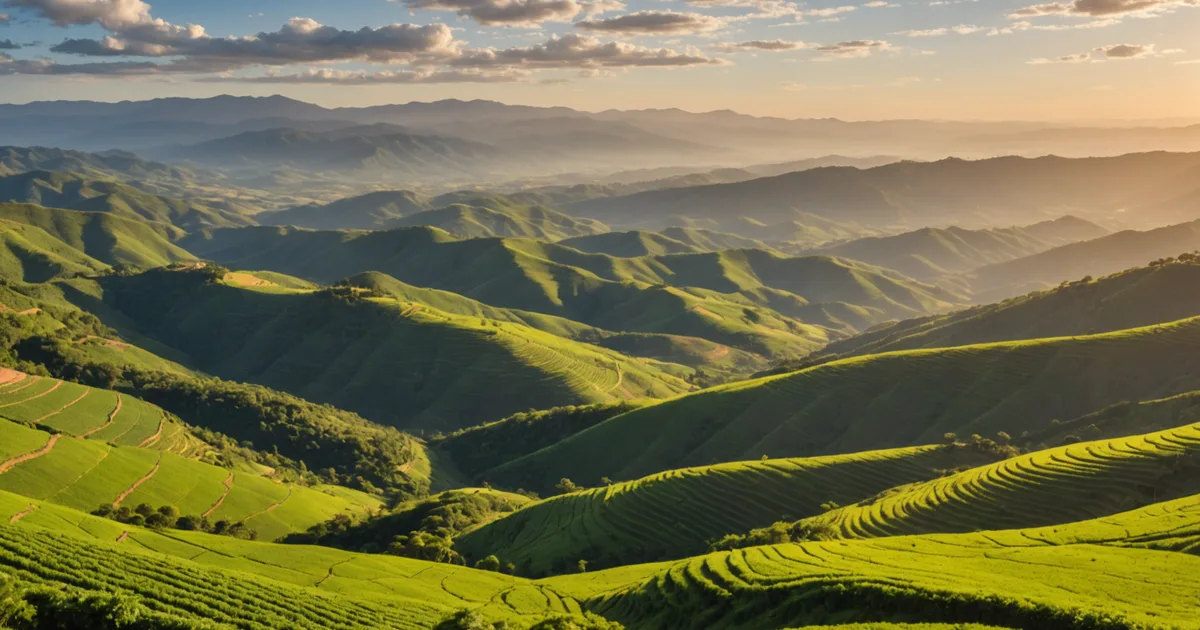
Brazil harvested roughly 63 million 60-kilogram bags of coffee in 2024, representing about 33 percent of global output. Sul de Minas and Cerrado Mineiro, both in Minas Gerais, contribute roughly half of the country's total. Yet comparing that production with formal rural credit disbursement data from the Banco Central do Brasil reveals nearly the opposite pattern: the smallest farms, despite producing the most coffee per hectare, regularly receive the smallest portion of formal lending.
The IBGE 2017 Censo Agropecuario recorded approximately 252,000 coffee-producing establishments across Brazil. Roughly 185,000 of them covered less than 50 hectares in total. In the census year, fewer than 15 percent of this group had credit access. That rate has not risen enough to alter the underlying structure. To see why, the financing system must be examined as it functions, rather than as policy documents present it.
The Scale of the Production and Credit Divide
Minas Gerais leads Brazil in coffee output, contributing roughly 55 percent of national production in most years. Inside the state, Sul de Minas supplies the greatest volume of specialty arabica. Its altitude zones, ranging from 800 to 1,300 meters, support slower bean maturation and stronger cup quality scores through their thermal conditions.
The farms behind this production are mostly small. In Sul de Minas, coffee holdings average well below 20 hectares. Many operate as family farms, with the grower, a spouse, and one or two hired workers handling 5 to 15 hectares throughout planting, flowering, and harvest.
These producers require working capital. Fertilizer is applied from January through March, well before the June-to-September harvest generates revenue. Harvest labor expenses also arrive within a narrow period. For a grower working 10 hectares, the time between paying for inputs and receiving harvest proceeds may represent R$15,000 to R$40,000, depending on prices and management intensity. That shortfall must be funded somehow.
PRONAF: Built for the Segment, Constrained in Reality
PRONAF, the Programa Nacional de Fortalecimento da Agricultura Familiar, was established specifically to offer subsidized financing to family farmers. The program now releases tens of billions of reais each year at annual rates of 4 to 6 percent, well below informal borrowing costs. From a policy standpoint, PRONAF is intended to address the smallholder credit shortfall.
In reality, accessing PRONAF begins with obtaining a DAP, or Declaracao de Aptidao ao PRONAF, through an authorized extension service or institution. In rural Minas Gerais, this usually involves EMATER-MG offices. Applicants must provide documents such as proof of property registration, family income records, and rural cadastre information. For growers in municipalities with limited extension coverage or incomplete land records, this initial requirement can be a barrier on its own.
After receiving a DAP, the farmer must submit the PRONAF request through an accredited financial institution. In rural Minas Gerais, these are generally Banco do Brasil, Sicoob cooperative branches, or Caixa Economica Federal agencies. Each institution applies its own review, including SERASA checks and income documentation. A grower may hold a valid DAP yet still be rejected because of a limited credit file and informal cash-flow records, even when a federal guarantee supports the loan.
Since the 2012 Forest Code, Cadastro Ambiental Rural, or CAR, registration has become a practical requirement in rural credit applications. CAR regularization varies across smaller municipalities. Farmers with incomplete or pending CAR records therefore face another documentation obstacle, one unrelated to their production history or ability to repay.
The Cooperative Financing Layer
Agricultural cooperatives in Sul de Minas give members some access to financing through seasonal capital initiatives and input credit. COOXUPE and other regional cooperatives provide pre-season lines for purchasing inputs, with repayment structured around harvest delivery commitments. For established members in good standing, this cooperative funding offers meaningful working capital support.
These programs generally have limits far below the sums a farmer may require for investments such as replacing aging plots, adding micro-irrigation, or purchasing processing machinery. They also depend on active membership and a satisfactory delivery record. Producers who use several sales channels, lack formal cooperative membership, or are new to the cooperative network do not receive the same access.
Coverage also differs by region. Sul de Minas and Cerrado Mineiro have comparatively dense cooperative networks, while Chapada de Minas and more distant growing areas have fewer options. In municipalities with limited service, cooperative credit may not reach a meaningful scale for someone needing R$20,000 to R$30,000 during input season.
Informal Financing and the Price of the Gap
When formal borrowing is out of reach, working capital still has to come from somewhere. Patterns described in rural credit research, and reflected in our own application pipeline, include suppliers extending seasonal input credit through pricing that embeds annualized interest, private lenders charging monthly rates that exceed 36 percent annually, and farmers selling future harvests below market value in exchange for planting capital upfront.
Pre-sale contracts, known as venda antecipada, become especially expensive when global coffee prices climb quickly. A farmer who sells 200 bags in advance at R$700 per bag in January to pay for inputs, then harvests after the market reaches R$950 per bag, has effectively absorbed the R$250 per bag difference as an implied financing charge. The exact amount depends on contract terms and timing, but the cost is substantial and may exceed formal borrowing costs, including commercial rates.
Expensive informal credit, combined with uneven harvest-based income, produces a cash-flow cycle that is hard to maintain over successive seasons. Farmers caught in it can accumulate financing problems, creating the repayment risk banks then point to when rejecting rural applications.
Why This Is a Structural Gap
The financing shortfall facing Brazilian coffee smallholders is not the result of bad intent. PRONAF is a real policy response. Cooperative lending reflects genuine organization among producers. Rural bank officers are not uniformly turning away viable borrowers for improper reasons.
The deeper issue is the missing information infrastructure needed to assess smallholder production risk efficiently at R$15,000 to R$40,000 loan sizes. Commercial bank underwriting relies on document-based reviews built for formal employees and businesses with accounting records. That approach routinely misreads agricultural smallholders, whose productive conditions are visible in agronomic information rather than financial statements.
This does not mean the document-based model was created to exclude smallholders. It was built around another borrower profile and was never redesigned for agricultural producers at scale. Exclusion results from applying one information framework to a group whose risk is better understood through another lens.
What It Will Take to Change the Picture
The answer is primarily an information infrastructure challenge, not a subsidy challenge. Subsidies reduce borrowing costs for people who already qualify. They do not alter the evaluation system that decides who can successfully apply.
Creating a pipeline that combines satellite canopy information, soil classification maps, cooperative yield data, and altitude measurements into a production risk score for small loans requires investment in data engineering and model development. It does not depend on government approval or bank infrastructure. It depends on a team prepared to build the system and enough grower applications to calibrate it.
Culttivo started this work in Sul de Minas because the region offers the richest and most accessible agronomic data. Altitude information is precise. EMBRAPA soil maps provide strong coverage. Regional cooperatives have digitized delivery records for their members. The ingredients for production-based credit assessment are present. What was missing was a pipeline that could combine them into a credit decision at a commercially viable underwriting cost. That is what we built, and what we are still calibrating as the pilot cohort expands.