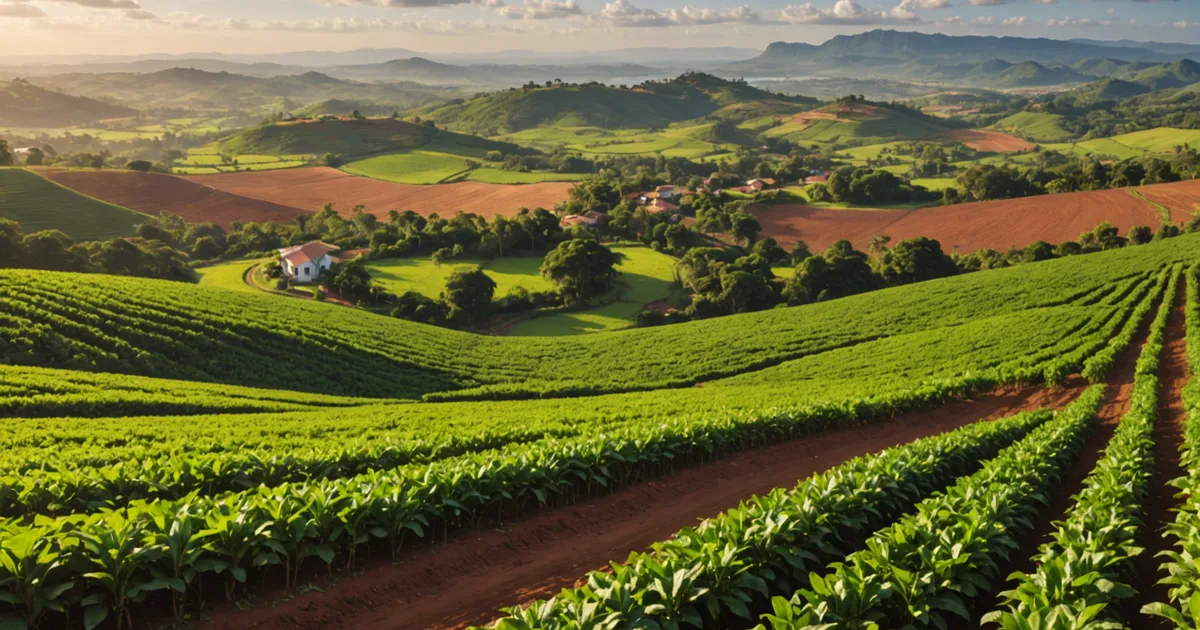
In the 2017 Censo Agropecuario, IBGE reported that under 20 percent of rural properties in Minas Gerais had obtained any institutional credit during the previous five years. This figure is often presented as proof that Brazilian smallholders are too risky for lenders. We see another explanation. Examining the information banks use to reject applications points less to "risky borrowers" than to "missing information."
The Data Banks Really Use to Score Borrowers
Brazilian retail credit scoring depends largely on SERASA and the Banco Central's SCR (Sistema de Informacoes de Credito). These databases record formal payroll history, tax filings, account activity, and earlier credit products. They were built around urban wage earners with formal employment contracts, and they perform reasonably well for that group.
A coffee smallholder in Carmo de Minas looks very different. Most work as individual rural producers (produtor rural pessoa fisica) or within informal family operations. Their income is seasonal and usually arrives in one or two harvest periods each year. Many have never had a formal employment contract, and some have never borrowed formally. In SERASA, the result is at best a thin file, or a score low enough that a branch bank credit officer will not examine the application closely.
Yet a thin SERASA file does not indicate whether a grower's twelve-hectare plot produces reliably. It reveals nothing about soil quality, altitude, canopy condition, or a cooperative's yield records for the past four seasons. The bank model cannot observe those factors. It detects missing payroll, formal income records, and credit history. In a generic scoring system, that absence is translated into risk.
What the Evidence Says About Rural Credit Risk
Professionals working with agricultural cooperatives understand something branch bank scorecards miss: productive coffee farms, especially in established Sul de Minas altitude zones, often generate predictable yearly income. The income is not identical each year, since weather and the biennial bearing cycle affect coffee yields. Still, a well-managed 10-hectare plot at 900 metres above sea level, with healthy soil organic content and a record of cooperative deliveries, is not an unknown risk. Its production history, soil classification, and satellite canopy readings form a consistent risk picture.
Rural cooperatives in Minas Gerais frequently provide informal credit to member growers because they possess this plot-level knowledge. They know which farms have delivered steady tonnage across several seasons and which producers have repaid grain-advance loans. The information remains in cooperative ledgers rather than flowing into SERASA. As a result, formal banks cannot interpret it.
This is fundamentally an information architecture issue. The evidence required to underwrite a smallholder loan properly already exists. It is spread among cooperative records, EMBRAPA soil maps, municipal rural cadastre registrations (CAR), and satellite imagery archives. Banks have not created the systems needed to ingest and score it. For large retail banks, the expense of building a rural underwriting model is substantial while smallholder loan amounts are limited. The business case for that infrastructure is therefore weak.
Why Missing Data Is Mistaken for Risk
High rejection rates, combined with elevated default rates on approved rural loans, are often interpreted to mean that rural lending is inherently risky. That conclusion mixes up the result of a flawed selection process with the actual risk of the wider borrower population.
Farmers who obtain formal bank credit are not a random cross-section of smallholders. They are more likely to have formal documentation, often because they run larger operations with enough land to support professional accounting. Smaller operators are more often rejected. If the approved group defaults at moderate rates, that does not confirm that the rejected group should have been denied. It describes only the approved group.
Informal credit also creates an adverse selection effect. Growers shut out of formal channels may obtain inputs on grain credit from suppliers at effectively very high annual rates, or borrow from informal lenders at even higher rates. Heavy debt-service costs raise the chance of default, and those defaults then become further evidence that small coffee growers are risky. The figures are genuine, but the direction of causation is partly reversed: informal-channel defaults are influenced by the interest rates themselves, not solely by borrower quality.
The Cooperative Ledger as Credit Evidence
Cooperatives in Sul de Minas have maintained member delivery records for decades. Recording each producer's harvest tonnage by season is standard practice. For growers who have delivered to one cooperative for five or more years, these records provide a yield history with roughly the same predictive usefulness as payroll data in formal employment.
Consistency of yields across seasons, adjusted for the biennial bearing cycle affecting Coffea arabica, says a great deal about farm management and site suitability. A producer who has delivered within 15 percent of expected yield over four seasons, despite changing weather, has shown a quality that a generic credit score cannot measure.
The difficulty is standardization. Cooperatives do not all structure their records alike. Some log deliveries by volume, others by weight, and others by bag counts covering different cherry grades. The information is available, but it must be cleaned and normalized before entering a scoring model. That is an engineering task, not an impossible barrier.
What We Are Not Claiming
To be clear, we are not saying that every rural credit rejection is unjustified or that smallholder lending is risk-free. Some farms truly operate under marginal conditions. Some producers have accumulated unsustainable informal debt. Some plots have degraded soils and no credible route to steady yields. A sound risk model should find those situations and reject or restrict credit as appropriate.
Our point is narrower: when a bank declines an application because the applicant has no SERASA history, it is responding to an information gap rather than measuring risk. The relevant information was not collected or scored. The grower could be low risk or high risk. The bank does not actually know. Treating "we don't know" as "high risk" is a policy decision, and it shapes who can obtain capital.
What Improved Underwriting Could Look Like
The necessary inputs are already available. Sentinel-2 supplies 10-metre multispectral imagery on a five-day revisit cycle. EMBRAPA maintains national soil classification maps at scales suitable for farm-level analysis. The CAR (Cadastro Ambiental Rural) records GPS boundaries for most rural properties in Brazil. Cooperatives hold years of yield records. INMET weather stations provide rainfall and temperature information tied to agricultural zones.
The missing piece is integration. These sources were not built to supply a credit model. Creating data pipelines, aligning formats, training a model specifically for Brazilian coffee production, and putting it into a 48-hour decision workflow is a product development task. It is difficult, but manageable.
That is the work underway at Culttivo. Our early-access pilot in Sul de Minas has provided initial data for model calibration. The technical path from GPS boundary to NDVI score, cooperative yield normalization, and credit decision is in place and operating. We are focused on improving accuracy and extending coverage as more growers join.
Banks have not created this pipeline because its economics do not fit their scale or ticket sizes. For a platform dedicated to Brazilian coffee smallholders, the economics are different. A specialized model trained on Sul de Minas production data may price risk accurately enough to make small-ticket lending viable. That is the premise we are testing.